Current Affairs Bangladesh 2026: Political, Economic & Social Updates

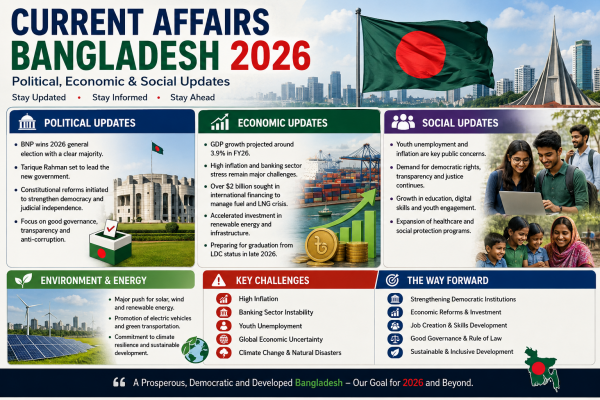
Bangladesh has been going through a period of rapid political and economic change. From debates over democratic reforms to concerns about inflation and employment, the country has remained in international discussions throughout recent months. If you regularly follow South Asian news, you have probably noticed how often Bangladesh appears in headlines related to politics, trade, climate risks, and regional diplomacy.
Understanding current affairs Bangladesh is important because the country plays a major role in South Asia’s economy and regional stability. Bangladesh is one of the world’s largest garment exporters, a densely populated nation facing climate challenges, and a country with a young population demanding reforms and opportunities. These developments affect not only Bangladesh but also neighboring countries and international trade partners.
Political Current Affairs Bangladesh
1. 2026 General Elections and Power Shift
One of the biggest political events in Bangladesh was the 2026 parliamentary election held in February.
- The Bangladesh Nationalist Party (BNP) won a majority in parliament
- Tarique Rahman became the Prime Minister of Bangladesh after returning from exile
- This election marked the first major political transition after years of instability
According to international reports, BNP secured a strong mandate, ending a long period of dominance by the previous ruling structure.
Voter turnout was around 59%, showing active public participation, though not as high as earlier decades.
Key point: The election is seen as a major turning point in Bangladesh political history.
2. Political Environment and Public Debate
After the election, political discussions increased across the country.
Main issues include:
- Demand for stronger democratic institutions
- Debate over corruption control
- Questions about administrative transparency
- Public concern about law and order stability
Student groups and youth organizations are also more active in political discussions. Social media plays a major role in spreading opinions and organizing public voices
3. Foreign Relations and Diplomacy
Bangladesh continues to maintain strong relations with:
- India – trade, border cooperation, energy exchange
- China – infrastructure, loans, and development projects
- United States & EU – garment exports and trade partnerships
Foreign policy is focused on balancing economic partnerships while maintaining national interests.
Bangladesh is also increasingly involved in regional discussions on climate cooperation and trade security.
Economic Current Affairs Bangladesh
1. GDP Growth and Economic Size
According to IMF estimates:
- Bangladesh GDP (2026): around $510 billion
- GDP growth rate: about 4.7%
- GDP per capita: around $2,911
This shows steady but slower growth compared to previous high-growth years.
Economic issue: Growth is continuing, but inflation and financial pressure are reducing real income benefits.
Inflation and Cost of Living Crisis in Bangladesh
Inflation continues to be one of the most serious issues in current affairs bangladesh.
According to Bangladesh Bureau of Statistics (BBS), inflation has stayed around 9%–10% in recent periods, mainly driven by food and energy prices.
Key price pressure areas:
- Rice prices increased by 12%–15% year-on-year
- Cooking oil and lentils saw sharp price jumps due to import costs
- Transport fares increased after fuel price adjustments
- Electricity bills rose in urban households due to higher fuel generation costs
Impact on daily life:
- Real income of middle-class families is shrinking
- Household savings are falling by nearly 20% in urban areas (estimates by local economists)
- Small businesses face rising input costs and lower profit margins
In simple terms: salaries are not increasing at the same speed as prices, which is creating financial stress across cities and rural areas.
Banking and Financial Stress in Bangladesh
The banking sector is under pressure due to long-standing structural issues.
Key financial indicators:
- Non-performing loans (NPLs) crossed Tk 1.5 trillion+ in recent estimates
- NPL ratio remains above 10% in several state-owned banks
- Foreign exchange reserves fluctuated around $20–24 billion range in recent months
Main concerns:
- Loan recovery is weak in several public banks
- Capital flow pressure due to import-heavy economy
- Dollar shortage affecting imports and industrial raw materials
Positive change:
- Mobile financial services (MFS) like bKash and Nagad now handle over 60%+ of digital transactions in urban areas
- Digital banking adoption is growing rapidly among youth and freelancers
This shows a mixed picture: traditional banking is under stress, but digital finance is expanding fast.
Garment Industry (Export Backbone of Bangladesh)
The ready-made garment (RMG) sector remains the strongest pillar of Bangladesh’s economy.
Key facts:
- Contributes around 84% of total export earnings
- Export value crossed $47–50 billion range in recent fiscal trends
- Employs about 4 million workers, mostly women
Major export markets:
- European Union (largest share, around 50%+ exports)
- United States (second largest buyer)
- Canada and UK
Current challenges:
- Global demand slowdown due to inflation in Western markets
- Rising production costs (electricity, transport, wages)
- Pressure from international buyers on compliance and labor standards
Despite challenges, the garment sector still drives Bangladesh’s foreign income and employment stability.
Energy and Power Situation in Bangladesh
Energy remains a critical issue in Bangladesh current affairs 2026.
Key energy facts:
- Peak electricity demand crossed 16,000+ MW in recent years
- Installed capacity is higher, but actual supply fluctuates due to fuel shortages
Current challenges:
- Dependence on imported LNG and fuel oil
- Dollar shortage affecting fuel imports
- Load shedding in some rural and semi-urban areas during peak demand
Government focus:
- Solar energy expansion in rural areas
- Rooftop solar programs in urban buildings
- Long-term shift toward renewable energy mix
However, fossil fuel dependency is still high, which keeps energy prices unstable.
Climate Change and Flood Impact
Bangladesh is consistently ranked among the top climate-vulnerable countries in the world.
Recent climate facts:
- Annual flood damage affects millions of people in low-lying regions
- River erosion displaces 50,000+ people every year (estimated range)
- Monsoon floods damage major crops like Boro rice and jute
Example impact:
Recent flooding in northeastern regions damaged large rice-producing areas, directly affecting food supply and pushing rice prices upward in local markets.
Consequences:
- Agricultural loss in multiple districts
- Food price instability
- Rural migration toward cities
Climate change is not only an environmental issue here — it is an economic and social crisis.
Education and Unemployment Situation
Youth unemployment remains a major concern in Bangladesh.
Key situation:
- Youth unemployment rate estimated around 10%–12% in urban areas
- Millions of graduates enter the job market every year, but job creation is slower
Main issues:
- Skill mismatch between education and job market needs
- Limited government job vacancies
- Slow private sector expansion in high-paying jobs
Changing trend:
- Freelancing workforce in Bangladesh is now one of the largest in the world (top 2–3 globally by volume in online platforms)
- Growth in IT services, digital marketing, and outsourcing work
Many young people are now relying on digital income instead of traditional jobs.
Social Awareness and Digital Growth
Bangladesh is seeing a strong shift in digital behavior.
Digital usage trends:
- Internet users: over 130 million+ active users (approx.)
- Social media penetration is increasing rapidly, especially among youth
What people talk about online:
- Inflation and daily expenses
- Job opportunities
- Political discussions
- Education reforms
Social media has become a major platform for public opinion and awareness campaigns.
International Current Affairs Bangladesh
Bangladesh plays an important role in regional and global discussions.
Key global importance factors:
- Garment exports to EU and USA
- Strategic location between South and Southeast Asia
- Large workforce population (over 170 million people)
- Climate vulnerability attracting global funding and attention
Trade and relations:
- China: infrastructure investment and loans
- India: border trade, electricity exchange, connectivity
- EU & USA: export-driven economic ties
Bangladesh is now seen as a growing manufacturing hub, but also a country facing serious climate and economic pressure at the same time.
30 Questions and Answers on Current Affairs Bangladesh
- Who is the current Prime Minister of Bangladesh?
Tarique Rahman is the Prime Minister after the 2026 general elections.
- What was the result of the 2026 Bangladesh election?
The Bangladesh Nationalist Party (BNP) won a parliamentary majority and formed the government.
- What is the GDP of Bangladesh in 2026?
Approximately $510 billion (estimated IMF figures).
- What is the GDP growth rate of Bangladesh?
Around 4.7% in recent estimates.
- What is the biggest economic sector of Bangladesh?
The ready-made garment (RMG) industry.
- What percentage of Bangladesh exports come from garments?
Around 84% of total export earnings.
- What is the main export market of Bangladesh?
The European Union, followed by the United States.
- How many workers are employed in the garment industry?
Around 4 million workers, mostly women.
- What is the main economic problem in Bangladesh?
High inflation and rising cost of living.
- What is the inflation rate in Bangladesh?
Around 9%–10% in recent periods.
- Why is inflation high in Bangladesh?
Due to food price increases, fuel costs, and import dependency.
- What is the biggest issue in the banking sector?
High non-performing loans (NPLs).
- What are non-performing loans (NPLs)?
Loans that borrowers fail to repay on time.
- What is the estimated value of NPLs?
Around Tk 1.5 trillion+ (recent estimates).
- What is the foreign reserve situation?
Around $20–24 billion range in recent updates.
- What is the main energy challenge in Bangladesh?
Dependence on imported fuel and gas.
- What is the peak electricity demand in Bangladesh?
More than 16,000 MW in recent years.
- What renewable energy is Bangladesh focusing on?
Solar energy and rooftop solar projects.
- Why is Bangladesh vulnerable to climate change?
Because of low-lying geography and frequent natural disasters.
- Which natural disasters are common in Bangladesh?
Floods, cyclones, and river erosion.
- How many people are affected by river erosion yearly?
Around 50,000+ people (estimated).
- Which crop is most affected by floods?
Boro rice, a major staple food crop.
- What is the youth unemployment rate in Bangladesh?
Around 10%–12% in urban areas (approx.).
- Why is youth unemployment high?
Due to skill gaps and limited job opportunities.
- What is a growing career trend in Bangladesh?
Freelancing and digital online work.
- How many internet users are there in Bangladesh?
Over 130 million active users (approx.).
- What role does social media play in Bangladesh?
It spreads news, political opinions, and public awareness.
- Which countries are major trade partners of Bangladesh?
India, China, USA, and European Union countries.
- Why is Bangladesh important in global trade?
Because of its garment exports and strategic location in South Asia.
- What is Bangladesh’s global importance?
It is a major textile exporter, climate-vulnerable nation, and growing manufacturing hub.
Conclusion
Bangladesh is currently experiencing major shifts in politics, economy, and social structure. The 2026 election has brought new leadership, while debates on governance, transparency, and democratic reforms continue across the country. Economically, growth remains steady, but high inflation, banking stress, and rising living costs are affecting daily life. The garment industry still supports exports and employment, even with global challenges. Climate change, floods, and unemployment remain serious concerns for long-term stability. At the same time, digital growth, freelancing, and social awareness are increasing rapidly. Overall, current affairs Bangladesh reflects a nation balancing progress and pressure in a changing environment.


